
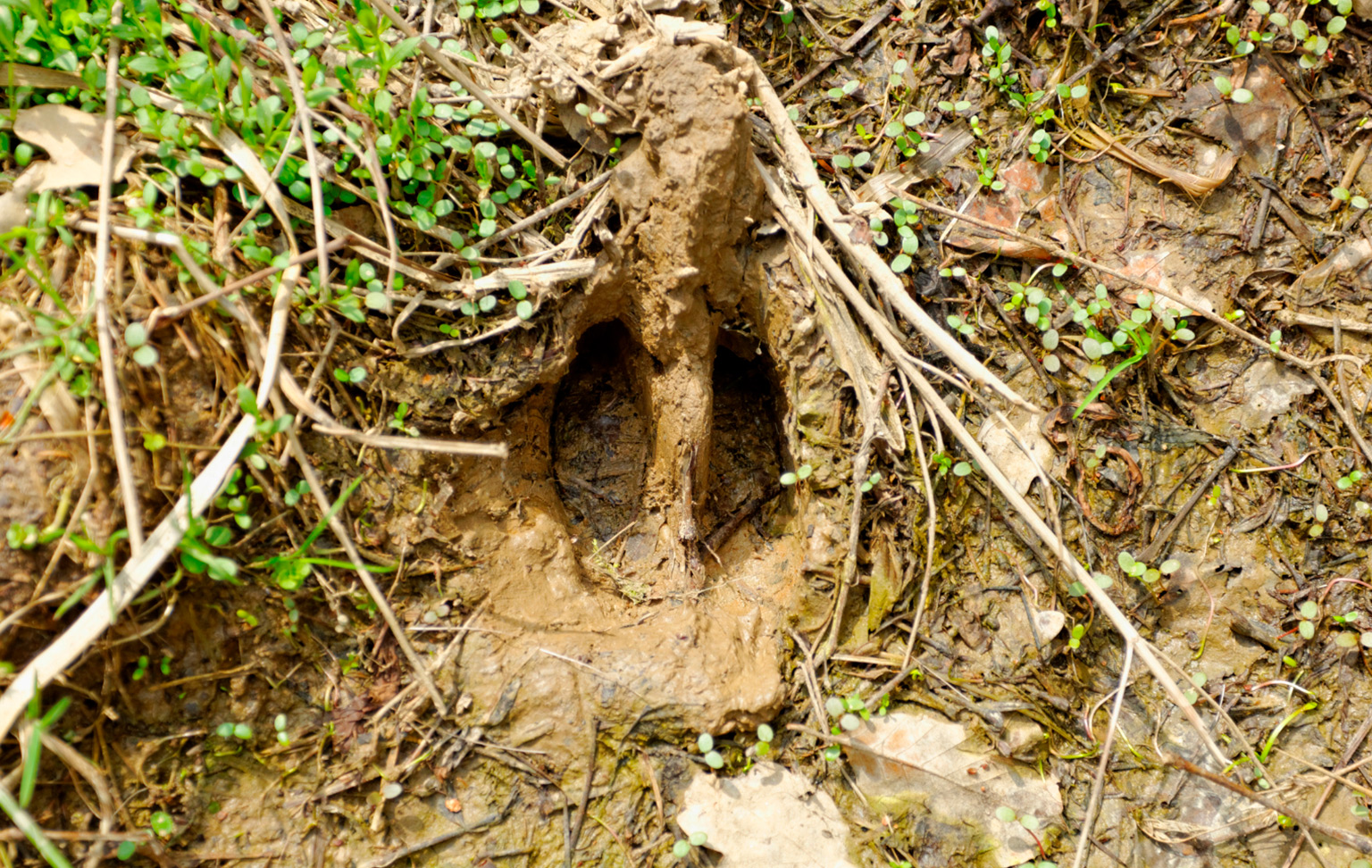
Reading the countryside: animal tracks, trails and signs
A mark in the mud, some disturbed leaves or a scratch on a tree trunk may go unnoticed during a walk. However, for those who stop to look, they form part of the information the countryside provides.
Reading the countryside involves observing animal tracks and trails, relating them to the terrain and assessing what they might indicate about the animals’ presence and activity. It is not about jumping to conclusions, but about gathering clues and recognising when information is missing.
For the hunter, developing this skill is a way of gaining a better understanding of the environment and enriching the experience of every outing. The key lies in combining attention, learning and respect for wildlife.
Footprints and tracks: what information can we find?
Footprints are the impressions left by an animal’s paws on a surface. But signs of animal activity include much more: feeding remains, droppings, marks on vegetation, trails and resting places.
The Spanish Society for the Conservation and Study of Mammals (SECEM) emphasises that these signs allow us to study animals that are often difficult to spot. It also warns that identifying them correctly requires learning: different species can leave signs that look similar.
That is why a good first question is: what am I actually seeing, and what am I assuming?
“There are two main types of hoof print,” describes one observation. “A large male passed through here this morning,” it adds, offering several interpretations that require further evidence.
1. How to examine a footprint without jumping to conclusions
Before identifying the species, examine the mark and the location where it appears
The shape and visible details
Look at the outline, the parts that have been imprinted and whether the track is complete. Look for other tracks nearby: a single distorted mark can be misleading.
In cloven-hoofed species, such as wild boar and deer, the secondary toes may also be visible when conditions allow them to be imprinted. Their absence from a track is not sufficient to rule out a species.
The terrain on which it was formed
An impression in soft mud does not preserve the same details as one in compact earth. The substrate determines the details we can observe, so it is advisable to compare several footprints and avoid identifying an animal based on a single measurement alone.
Size can be helpful, but it must be assessed alongside shape, sequence and other clues. SECEM points out that footprint characteristics also vary within the same species.
The sequence of tracks
When there are several tracks, observe their arrangement and continuity without stepping on them. The sequence provides more context than an isolated track.
Avoid turning an incomplete observation into a definitive statement about the animal’s weight, sex or age. In many cases, it is best to classify the identification as ‘probable’.
2. Other signs that help interpret the woodland
Observation improves when we stop looking solely at the ground. The forest education materials from the Regional Government of Castile and León include, amongst the signs of activity, resting places, rolling areas and marks left on the vegetation.
Food remains and disturbed soil
Gnawed fruit, consumed shoots or disturbed soil can guide the search for other clues.
A disturbed area, on its own, does not allow the culprit to be identified with certainty. Examine the surroundings: are there recognisable tracks? Are there food remains? Do the signs form a coherent whole?
Scratches and marks on tree trunks
Note the height, the appearance of the bark and the presence of other nearby signs. Avoid automatically attributing any scratch to a particular species: damage may also have causes other than wildlife activity.
Droppings
These can provide information for identification, but interpreting them requires experience and comparison with reliable reference material. The shape, size and contents are not always consistent.
For educational purposes, it is sufficient to photograph them without touching or disturbing them.
Lying places and trails
An area of flattened vegetation or a small path through scrub may catch your eye. Even so, these do not in themselves prove which animal uses them, how often, or when it was there.
There is no need to venture into a resting area to confirm a suspicion. Observing from the outside allows you to preserve the evidence and avoid disturbance.
3. Can you tell if a track is recent?
This is one of the most common questions and also one that requires the greatest caution.
The condition of a sign depends on factors such as rain, wind, humidity, exposure and the type of ground. A clearly defined footprint does not automatically mean it is only a few hours old.
The practical advice is to record what you do know: when you found it, what the ground was like, and what you know about the weather in that area. If you cannot determine its age, note ‘undetermined’.
The same applies to habits: finding a sign once does not prove that there is regular use. To assess patterns, repeated observations and context are required.
4. A simple method: observe, record and cross-check
You don’t need to identify every sign from day one. You can start by following a routine:
-
- Observe the whole picture. Look at the sign and how it relates to its surroundings.
- Take photographs without disturbing the scene. Take one general view and one close-up.
- Include a scale reference. Place a ruler next to the footprint, without touching or distorting it.
- Note down the context. Date, location, surface and conditions observed.
- Distinguish between fact and interpretation. Separate what is visible from your proposed identification.
- Consult a specialist guide. Compare various features and accept that some tracks will remain unidentified.
This type of organised record is consistent with the documentation of evidence used in technical wildlife monitoring work, although a single observation does not replace professional sampling.
A simple note can be more useful than a definitive conclusion:
“Three hoof prints in mud, beside a path. Photographs with scale. Probable species, to be confirmed.”
5. How to apply your observations to planning an outing
Knowing the countryside also means recognising its slopes, crossroads, difficult passages and landmarks.
Before setting off, plan your route and return journey, check the weather forecast and work out the daylight hours. During the outing, ensure that your interest in a trail does not cause you to lose sight of the path.
A track used by animals is not necessarily a suitable route for people. Do not make decisions about your direction based solely on it.
For those who hunt, reading the terrain must be integrated into safety planning and the organisational guidelines for each outing. Finding a marker does not justify altering a planned route on your own initiative.
Common mistakes when interpreting tracks
- Identifying a species from a single, incomplete footprint.
- Deducing weight or sex solely from the size of the footprint.
- Estimating the time of passage without sufficient information.
- Interpreting multiple tracks as belonging to many different animals.
- Assuming a track observed only once is a regular occurrence.
- Disturbing a track before photographing it.
- Forcing an identification when the details do not allow it to be confirmed.
Learning to recognise these limitations is part of the learning process. Experience helps you to ask better questions, as well as find answers.
What to take for comfortable observation.
Simple equipment makes the outing easier: a mobile phone or camera, a notebook, a pencil, a small ruler and an identification guide. Binoculars allow you to observe your surroundings whilst keeping your distance.
Choose clothing suitable for the weather forecast and footwear appropriate for the terrain and the length of the day’s outing. Observation stops are interspersed with walks across surfaces that may be damp or uneven.
Frequently asked questions about animal tracks and traces
What is the difference between a track and a trace?
A track is the imprint of a paw. ‘Trace’ can refer to a sequence of tracks and, in a broader sense, to other signs left by an animal’s activity.
Does a footprint always allow you to identify the species?
No. It may be incomplete, distorted or share characteristics with those of other species. It is advisable to compare several footprints and other clues.
Do lots of footprints mean there are lots of animals?
Not necessarily. A single animal may pass by several times and leave numerous impressions. The abundance of animals requires specific study methods.
How can I learn to identify tracks?
Combine observation, scale photographs and consulting specialist guides. Tracking workshops with professionals also help to correct mistakes and compare examples in the field.
Every outing is an opportunity to learn
Reading the countryside requires attention and patience. Sometimes you’ll recognise a sign; other times, you’ll return with a photograph and a question to be resolved later.
That’s part of its appeal: discovering details that previously went unnoticed and getting to know the terrain better without disturbing what goes on there.
- Big Game (6)
- Chiruca (9)
- Fairs (2)
- Hunting and technology (1)
- Hunting dogs (6)
- News (14)
- Relevant information (51)
- Small Game (2)