
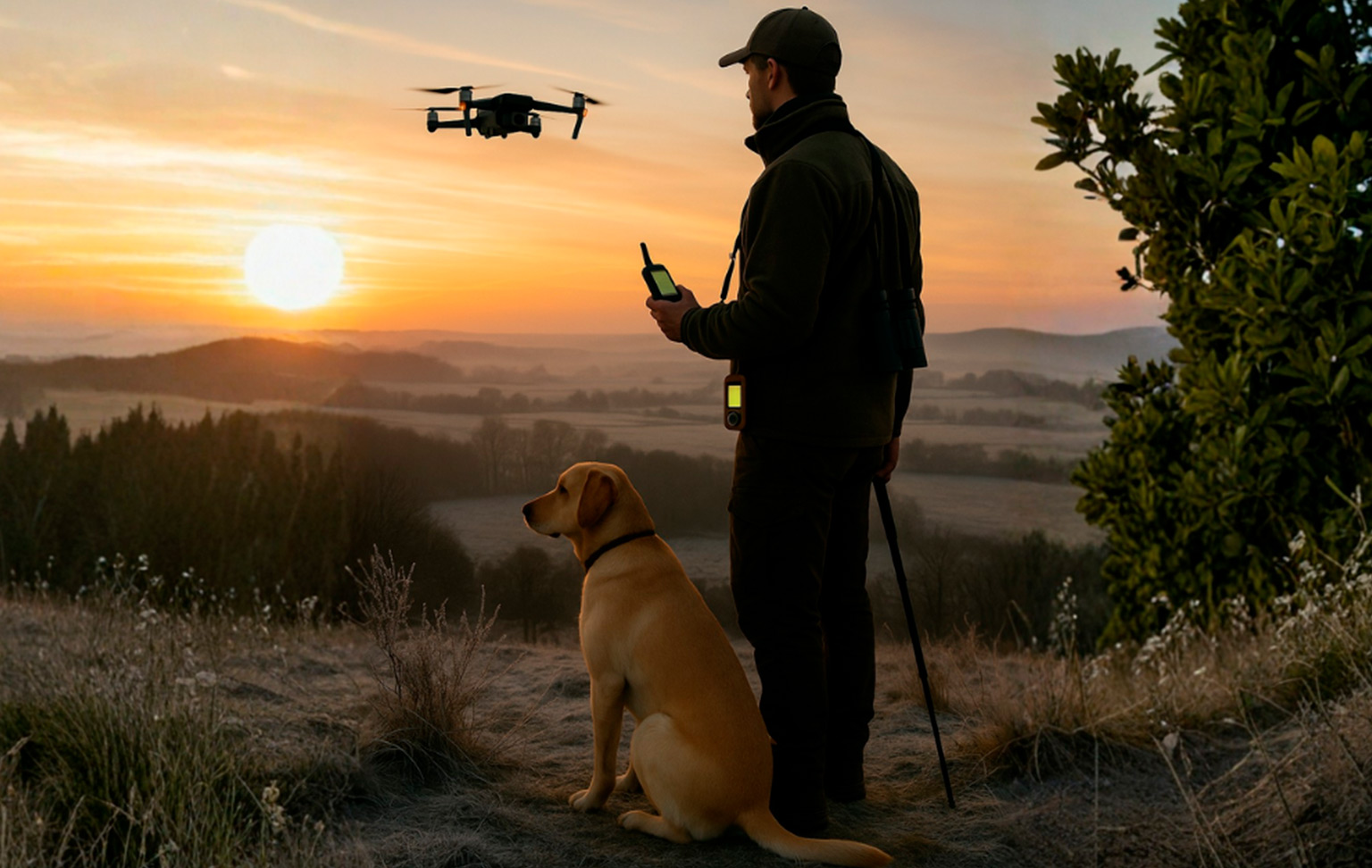
Technology at the service of the hunter: drones, apps and useful devices (always ethically and within regulations)
How new technological tools are transforming responsible hunting.
Modern hunting is undergoing a period of transition. Knowledge of the terrain, tracking, weather forecasting, and coordination between hunting parties remain traditional skills… but today they can be complemented by technological tools that improve safety, efficiency, and the planning of hunting days.
However, in the hunting field there is a golden rule:
Technology is only an ally if it is used ethically, responsibly, and within the regulations.
This article lists the technologies permitted for general use, those that require specific conditions, and those that CANNOT be used in hunting, explaining it clearly, unambiguously, and rigorously to avoid errors.
1. Drones and hunting: what is allowed and what is not
This is undoubtedly the most delicate point.
And we must be absolutely clear:
✔️ 1.1. Use of drones during hunting operations
It is not permitted to use drones to locate, detect, track or push wildlife during a hunting action.
This is common to all Spanish regional regulations, and also coincides with European legislation on non-selective methods.
That is to say:
❌ Drones cannot be used to “locate” parts.
❌ Drones cannot be used to “move” or “lift” animals.
❌ Drones cannot be used to guide shots.
❌ Drones cannot be used for direct surveillance of animals before the hunt.
This point does not admit of interpretation.
✔️ 1.2. When CAN drones be used
There are legal and responsible uses that have nothing to do with hunting:
- Preliminary site reconnaissance, several days in advance, to study access routes, ravines, firebreaks, meeting points, hazardous areas, etc.
- Support for the security of the hunting area: checking boundaries, closed trails, areas affected by storms, etc.
- Habitat management tasks, such as monitoring the condition of ponds, natural crossings, and the hunting area’s infrastructure.
- Search and rescue operations, always within the legal framework forrecreational/professional drones.
In these cases, the drone is not used to gain an advantage over wildlife, but as a logistical tool.
✔️ 1.3. Important in all cases
Even for permitted uses, the drone is subject to:
- AESA regulations (since 2021, categories Open/A1-A3, Specific, and Certified).
- Height and distance limits.
- Flight restrictions in protected areas or near urban centers.
- Requirement to hold a license if applicable (minimum A1/A3) depending on the drone type.
Use, yes; hunting advantage, never.
2. Thermal cameras and night vision: observation vs. action
Here, precision is fundamental because many conceptual errors are made.
✔️ 2.1. Thermal monoculars / thermal observation cameras
Its use for observation is permitted, always outside the moment of the attack and without mounting on weapons.
They are used for:
- Detecting residual heat in passageways (without directly intervening),
- improving safety while moving around,
- observing wildlife without influencing its behavior.
They are common tools in game reserve management and game wardenship.
✔️ 2.2. Thermal or night vision sights mounted on weapons
Here the rule is unequivocal:
❌ They are not permitted for hunting in Spain, except for specific authorizations for population control or damage to crops, issued by the competent administration.
These exceptions:
- They are granted on a case-by-case basis,
- depend on each autonomous community,
- require justification,
- and NEVER authorize their use in sport hunting.
✔️ 2.3. Clip-on type night accessories
Same case:
❌ Its use on the weapon is not permitted without specific authorization.
3. Really useful apps for hunters (all legal and recommended)
The 21st-century hunter constantly uses apps, many of which are security, communication, and planning tools. Here are only the safe, legal, and universally accepted ones.
3.1. Weather apps
Meteorology is a critical factor:
- AEMET — Accurate, official and reliable.
- Meteoblue — Very detailed and with wind models.
3.2. Map and navigation apps
They allow planning for entrances, exits, and complicated areas:
- OruxMaps — One of the most used by work crews.
- Gaia GPS — Very complete and accurate.
- Wikiloc — For recording your own tracks and basic orientation.
3.3. Communication apps
Key to security and coordination:
- Zello — Voice-activated walkie-talkie.
- WhatsApp — Logistics and quick notifications.
- Telegram — Structured and stable groups.
3.4. Useful apps for managing the hunting reserve
Depending on the community or federation, there may be specific apps for:
- access control,
- activity permissions,
- capture report,
- observation notification.
Here it depends on each autonomous community, so they are never mentioned by name except in universal cases.
3.5. Ballistics apps
Legal as long as their use is for guidance only, never to obtain an illicit advantage:
- ballistic tables
- projectile drop
- wind corrections
These tools are acceptable as long as they do not interfere with the ethics of the hunt or local regulations.
4. Other useful and 100% safe technologies
✔️ 4.1. GPS and collars for hunting dogs
Completely legal and widely used for:
- Avoid getting lost,
- control distances,
- improve the dog’s safety,
- locate it quickly in difficult areas.
The GPS does not affect the behavior of the hunted animal, so its use is ethically impeccable.
✔️ 4.2. Clothing and technical equipment
Technology applied to:
- Silent fabrics,
- breathability,
- waterproofing,
- thermal protection,
- lightweight backpacks,
- ballistic-protected lenses.
All of this fits perfectly within modern hunting.
✔️ 4.3. External batteries and charging systems
It may not look like “hunting technology,” but it’s essential for safety:
without a battery there’s no GPS, communication, or coordination.
Hunting ethics in the digital age
Technology is a powerful tool.
But there’s one principle that hasn’t changed:
A responsible hunter never uses technology to gain an advantage over wildlife, but rather to improve their safety and that of the environment.
Therefore, the key is always this:
Technology YES → if it’s for security, logistics or management.
Technology NO → if it directly interferes with the hunt or the behavior of the wildlife.
Hunting evolves, but the principles remain the same.
Drones for surveying the terrain, apps for orientation, GPS for dogs or thermal monoculars for observation are valuable allies… always with responsibility and respect.
Knowing what can be used, what cannot, and under what conditions, not only avoids penalties:
It is part of the ethics of today’s hunter.
- Big Game (4)
- Chiruca (4)
- Fairs (2)
- Hunting and technology (1)
- Hunting dogs (6)
- News (11)
- Relevant information (36)
- Small Game (1)