
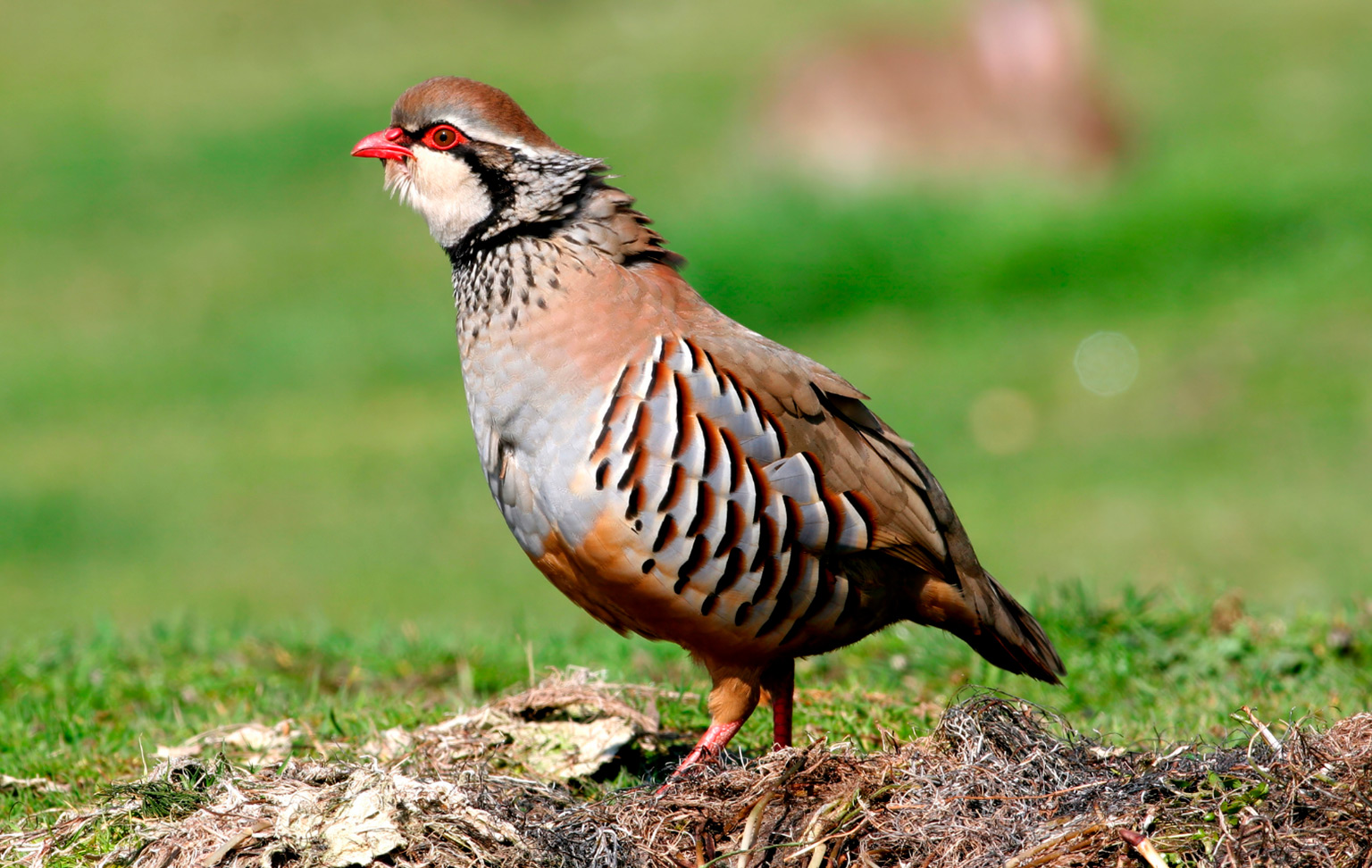
Holm oaks and olive groves: red-legged partridge hunting season
There are landscapes that seem designed for small game hunting. Not because of romanticism or written tradition, but because for generations they have proven to harbour wildlife in balance.
Among them, few settings better represent the essence of Iberian hunting than the sparse oak groves and traditional olive groves, areas where the red-legged partridge remains, when land management allows, the true star.
To speak of red-legged partridge hunting in these environments is to speak of patience, observation and respect for a bird that rarely grants free advantages.
The landscape: a mosaic that explains the presence of the partridge
The red-legged partridge does not depend on a single type of terrain, but rather on a combination of several elements. Where holm oaks, crops and patches of scrubland alternate to form an irregular mosaic, the chances of finding stable populations increase.
Open holm oak woodland provides shelter and quiet areas for roosting. The shade, vegetation cover and reduced human pressure during part of the year make these areas safe places to rest. It is not so much the tree itself as the structure of the terrain: clearings, scattered bushes and sufficient visibility to detect danger.
Traditional olive groves, especially the less intensive ones, provide another important component. Wide paths, boundaries with natural vegetation, embankments and small areas without tillage provide food and easy passage for partridges, which prefer to run rather than fly when conditions allow.
It is advisable to be cautious: not all olive groves are home to partridges. Highly intensive farms, without vegetation cover or nearby shelter, are usually unfavourable. The presence of the species always depends on agricultural management, hunting pressure and the existence of nearby quiet areas.
Reading the terrain: where to actually look for them
One of the most common mistakes is to think that partridges appear randomly. In reality, they tend to repeat their favourite spots as long as they are not overly disturbed.
During the cold months, they are often found taking advantage of sunny slopes in the early hours of the day. When the ground warms up, they tend to move to areas with more cover or to wind-protected valleys.
Some places where they tend to congregate are:
- Edges between olive groves and natural woodland.
- Rarely used paths and their margins.
- Dry streams or small depressions in the terrain.
- Areas where ploughing leaves strips of unworked land.
These are not absolute rules. Partridges adapt their behaviour to hunting pressure and human presence, so what works in one hunting ground may not work in another.
Rather than looking for “magic spots”, experienced hunters look for signs: tracks in soft ground, recent scratches or loose feathers. Even silence can be indicative; when the field seems empty after several days of pressure, the partridges have often simply moved on.
The hunting day: pace and patience
A typical day begins long before the first shot. The choice of route, the wind direction and the planning of the advance determine much of the outcome.
In open terrain with holm oaks and olive groves, walking too fast usually works against the hunter. Partridges detect movement from a great distance and choose to run, taking advantage of any undulations in the terrain. When they finally take flight, they do so far away and with an advantage.
Well-organised teams, when the type of hunting allows, seek to close off natural exits without rushing their advance. For hunters on the wing, the key is often to stop longer than instinct dictates and observe before continuing.
The shot is rarely easy. Long runs, low flights and changes of direction require measured shots. Here it is worth remembering something basic: not all shots should be taken. Safety, reasonable distance and shooting ethics remain an essential part of the day.
The role of the dog
In these areas, dogs make a big difference, although their work varies depending on the type of hunting practised.
Pointing dogs help locate partridges that try to hide in patches of cover or among scattered bushes. In olive groves, where visibility can be deceiving, a firm point prevents birds from being flushed out of range.
Flushers, on the other hand, are effective in more open areas as long as they maintain a controlled range. Excessive range usually results in distant flushes.
More than the specific breed, what matters is the balance between initiative and obedience. Wind, temperature and dryness of the terrain have a significant influence on the dog’s work, so each day requires adaptation.
Technique and strategy in open terrain
Red-legged partridge rewards observation. Some principles are often repeated among experienced hunters:
- Take advantage of the terrain to conceal your approach.
- Avoid silhouetting yourself on ridges or visible areas.
- Advance with frequent pauses.
- Anticipate that many partridges will seek to flee downhill before flying.
There are no foolproof formulas. Part of the appeal of this hunt lies precisely in its uncertainty.
Ethics and management: the future of the species
Today more than ever, talking about red-legged partridges means talking about responsible management. Natural populations depend on multiple factors: climate, agriculture, predation and hunting pressure.
Respecting quotas, limiting hunting days and conserving refuge areas help to maintain sustainable densities. Similarly, more and more managers agree on the importance of habitat over quick fixes.
Hunters are part of the balance when they understand that a good season is not measured solely by the number of catches, but by the future health of the land.
The end of the day
When the sun sets behind the holm oaks and the air begins to cool again, the day usually leaves behind more than just the game bagged. There are the missed shots that are remembered with unexpected precision, the work of the dog and that difficult-to-explain feeling that only comes after walking for hours reading the terrain.
The red-legged partridge, elusive and demanding, remains one of the best teachers for those who enjoy hunting as a continuous learning experience. And perhaps that is why, among holm oaks and olive groves, each day still seems different even though the landscape is the same.
- Big Game (5)
- Chiruca (5)
- Fairs (2)
- Hunting and technology (1)
- Hunting dogs (6)
- News (12)
- Relevant information (40)
- Small Game (2)