
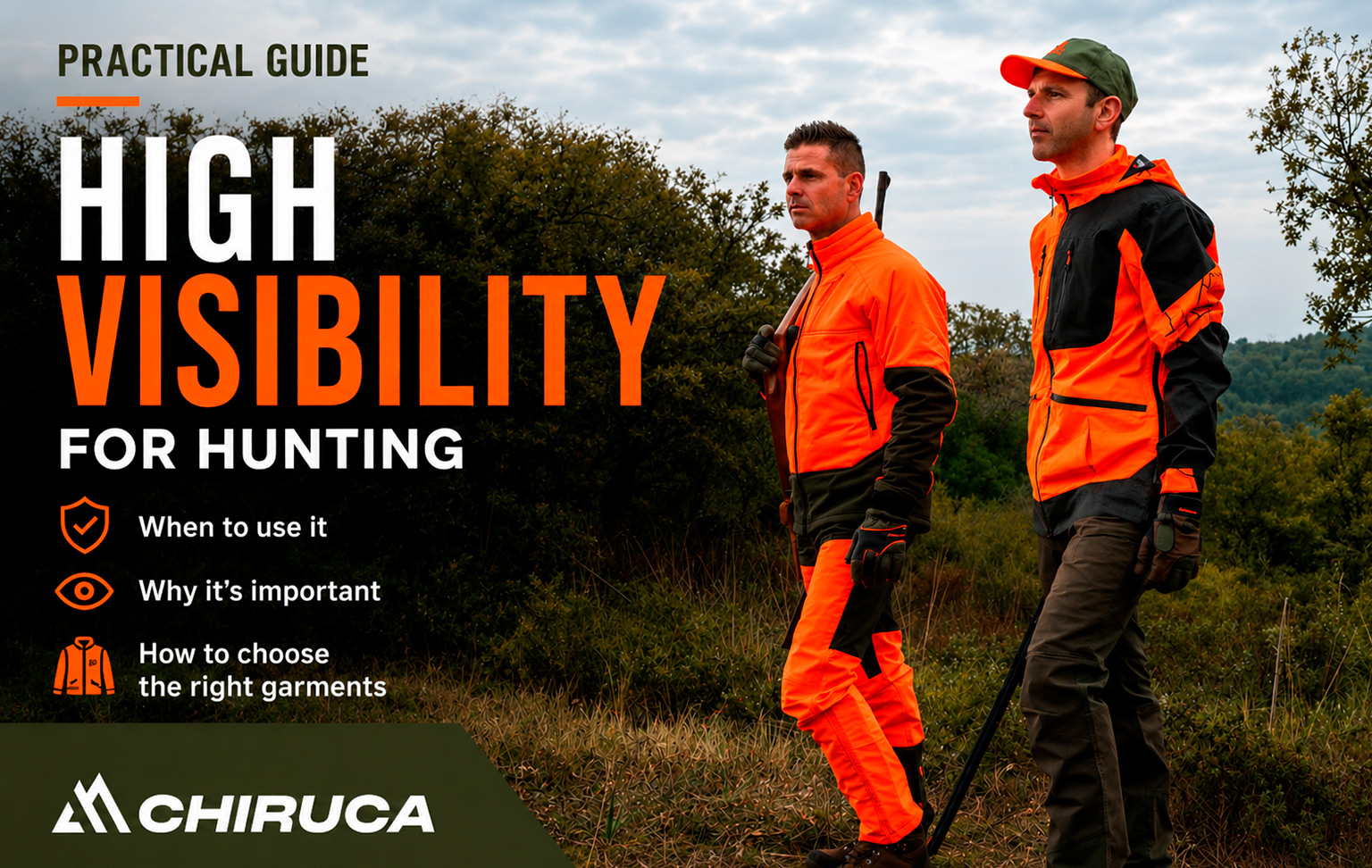
A practical guide to high-visibility clothing for hunting: when to wear it, why, and how to choose the right garments
Safety has always been one of the cornerstones of hunting. In group hunting activities such as driven hunts, battues or hunts with beaters, where numerous hunters, packs of hounds and constant movement across the terrain are involved, visibility among participants is no longer a mere detail but an essential requirement.
In recent years, high-visibility clothing for hunting has evolved significantly. It is no longer simply a matter of wearing a striking orange garment, but of incorporating technical, comfortable and functional elements that allow each hunter to be quickly identified without compromising mobility, weather protection or ergonomics.
Why is high visibility important in hunting?
The main function of high-visibility clothing is to reduce the risk of accidents resulting from late or poor identification of other participants.
In group hunts, particularly in terrain with dense vegetation, uneven ground or reduced visibility, fluorescent colours help to quickly detect human presence even at a long distance or through obstacles.
Furthermore, many regional authorities and hunt organisers recommend, and even require, the use of high-visibility items during certain group hunting activities.
The scenarios where it makes the most sense to wear high-vis clothing are:
-
- Driven hunts
- Wild boar drives
- Hook hunts
- Stalking in shared areas
- Hunting on foggy days or in low light
- Hunting days where there is a simultaneous presence of walkers, livestock or forestry activities
The key is not simply to ‘wear orange’, but to do so strategically and in a way that is visible from different angles.
When to wear high-visibility clothing
During driven hunts and wild boar drives
This is the most obvious context. There is constant movement of dogs, hunters, beaters and vehicles. Positions can vary and, on many occasions, shots are fired quickly.
Here, the following are particularly recommended:
- Vests or jackets with large fluorescent areas
- Caps visible from a long distance
- Visible accessories on legs and arms
A garment such as the Chiruca Febo 08 is designed precisely for this type of scenario, combining external protection with well-distributed high-visibility panels.
In areas of dense vegetation
Thickets, dense pine forests or scrubland make visual identification very difficult. In these cases, even a small visible accessory can make all the difference.
Accessories such as the Chiruca Hi-Vis 08 Cap help keep your head visible when the rest of your body is partially covered by vegetation.
On cold or foggy days
In winter, overcast dawns or damp days significantly reduce visual perception. The use of fluorescent layers becomes even more important.
Visible thermal accessories such as the Tubular Polar Fino 08 allow you to maintain thermal protection without losing visibility.
How to choose the right high-visibility clothing for hunting
Not all Hi-Vis garments are the same. Your choice should be based on the type of hunt, weather conditions and level of physical activity.
1. Prioritise actual visibility, not just fluorescent details
Some garments feature small orange details that are purely aesthetic. For group hunting, it is important that the visible surface area is large and recognisable from a distance.
Models such as the Osiris Hi-Vis 08 or Onuris 18 are designed precisely to offer clear identification in the countryside.
2. Consider mobility
A garment that is too stiff or heavy can end up being uncomfortable during long days out.
For driven hunts involving a lot of movement or dynamic hides, it is best to opt for lightweight, flexible garments that allow you to handle your gun naturally.
The Axe 08 is a good example of a garment designed to combine lightness and visibility.
3. Choose the right layering system
One of the most common mistakes is to hide the high-visibility garment under waterproof or warm layers.
Visibility must always be maintained on the outer layer. To achieve this, it is advisable to use:
- Hi-Vis outer jackets
- Visible gaiters
- Fluorescent caps
- Visible neck accessories
The Hi-Vis 08 gaiters also provide protection against damp, mud and dense vegetation.
4. Adapting your clothing to the weather conditions
A cold winter hunt is not the same as an early autumn drive.
For cold days, models such as:
allow you to maintain thermal insulation and weather protection without compromising on proper visual visibility.
The importance of high-visibility footwear
Although it is often overlooked, leg movement is usually one of the first visual cues to be spotted amongst vegetation.
Hi-Vis boots and accessories are particularly useful in:
- dense woodland
- moving between hunting posts
- crossing clearings
- moving around in low light
Chiruca also offers several models of boots with high-visibility features, which can be viewed here:
High visibility and hunting ethics
Safety whilst hunting does not depend solely on rules or regulations. It is also part of every hunter’s individual responsibility.
Wearing high-visibility clothing conveys:
- respect for fellow hunters
- professionalism
- commitment to safety
- awareness of the shared environment
Furthermore, it helps to project a modern and responsible image of hunting, something particularly important in a context where the public perception of hunting is increasingly under scrutiny.
High-visibility clothing for hunting should no longer be seen as an optional accessory reserved solely for certain types of hunts. Today, it represents an essential tool for improving safety in the countryside and minimising risks during group hunts.
Choosing the right Hi-Vis jackets, accessories and footwear allows for increased visual detection among participants without compromising on comfort or technical performance.
Because in hunting, seeing and being seen can make all the difference.
- Big Game (6)
- Chiruca (6)
- Fairs (2)
- Hunting and technology (1)
- Hunting dogs (6)
- News (13)
- Relevant information (49)
- Small Game (2)